

Packing Smart

Let’s face it, as anglers we all suffer from the same affliction – Tackle Addiction. The moment you think you have everything you need, something else catches your eye and before you know it you’ve accumulated mountains of gear! Don’t misunderstand me, there is nothing wrong with this (I actually think it’s normal!) and half the fun of fishing is building an arsenal of toys, is it not? The problem arises when it’s time to go fishing. Most times it’s near impossible to take all your gear along and becomes worse when you have to travel (by air) with gear and are restricted by the amounts of gear you’re able to travel with. This is where hours and hours of debate take place before a trip…. I find myself mixing and matching for hours on end as I try and decide who needs to come along and who needs to stay behind…. And often will have to let some lures down… “Look, I really like you but I think it’s best if you sit this one out…” Then problem, you head off to a destination you are unfamiliar with, and so start dreading getting there with something you needed but left behind, or even worse, you pack one of a certain kind of lure and then think that it may be “the one” so end up trying to pack multiples of the same lure. Before you know it you are way over the airline weight restrictions and have to fork out more for overweight baggage than the ticket itself! Let’s not talk about trying to haul all that gear around airports etc to get it to the destination safely.
The focus of this write up is sharing my system of “How to pack” and a little bit of “what to pack” (we can get into the details of this aspect in another instalment).
Let’s start at the beginning then, you’ve got your mates together and booked a 4-6 day trip to an exotic offshore destination with Go Fish Tours. Your primary fishing methods will be popping, jigging, some spinning and a mix of light tackle fishing targeting top water gamefish, pelagic’s and anything else that’s willing to eat out there. You need to try and cover off techniques, species and situations in your packing but more importantly:
- Limit your weight to airline restrictions
- Pack your gear in a manner that protects your prized possessions as best you can from travel and airport baggage handlers – we all know how they love to tenderly look after fragile cargo!
- Pack everything you need but also remain mobile while travelling with gear – many destinations don’t have the luxury of airport trolleys, porters or even paved walkways to roll baggage around
- Pack in a manner that allows you to remain efficient and organized after reaching the destination and when you’re on the boat. The worst is having all your gear but having it packed all over the show wasting precious time when you need access to something quickly when out on the water
- Lastly, you don’t want to be like Kirk, who is constantly stopped by airport security because he has trebles and jigs falling out of everywhere, or him trying to sneak an extra 4 poppers in his jocks as hand luggage or getting to the counter and needing 4 airport staff to lift his bag onto the scale!
Basic General Airline Guidelines
1 x personal item (laptop bag)
1 x Fishing Rod tube max 2m long @ 10kg
1 x hand-luggage @ 7kg
1 x Check in bag @ 23kg
Personal item (Laptop Bag/backpack)
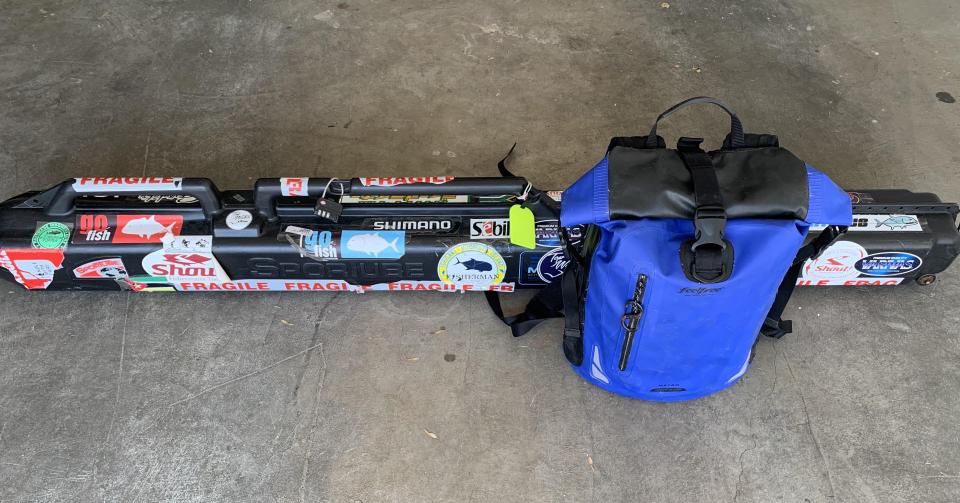
Ensure this is not an oversized backpack that looks like a second piece of hand luggage or you might have issues. I use a medium sized 25/30l roll top waterproof backpack. What goes in here:
- Travel documents (passport, tickets, travel; insurance, cash)
- Laptop/tablet (to get some work done(saying this in case my boss is reading this) but also to offload photos and footage after a day on the water)
- GoPro, drone, camera and accessories
- Spare batteries, charging cables, power packs, plug adaptors, headlamp
- Sunglasses
- Some snacks (Any little spare space can take some biltong)
The main reason I use a waterproof backpack, is that once I get onto the boat, I use it as a wet-deck bag to keep cameras and other valuables dry. Secondly, there are often destinations which offer the opportunity to also have some land-based sessions and having a backpack to throw a couple lures in while wading flats or walking the beach has proved very valuable.
Fishing Rod Tube (10kg)
When booking your flight, it’s a good idea to check the airline’s sports equipment allowance to ensure your tube qualifies – I am yet to have a situation when it doesn’t. Typically, you’re only allowed one piece of luggage as sports equipment (fishing) with a maximum weight of 10kg and a maximum length of no longer than 2m.
- It will save you thousands (in having to replace gear) if you invest in a good quality rod tube. Yes, home-made PVC tubes do the job but they are not ideal – they’re heavy, prone to shattering on impact, difficult to cart around, non-adjustable and don’t hold enough gear.
- There are a few good options in terms of quality, adjustable rod tubes most common being the Plano Airliner, the Sportube Series (I have fitted up to 10 rods in mine) and those made by Natureboys (though these are not easy to get in SA)
- The reason these are the best tools is because they are
- adjustable and lockable
- made of durable plastic material that can take the abuse of airport baggage handlers as well as the odd fall
- they swallow immense amounts of gear
- they are lightweight and…
- lastly they have wheels for easy manoeuvrability.
Rod tube packing Tips
• Given that the allowance is 10kg, fishing rods in a rod tube (not PVC which is very heavy) weight around 5-6kg leaving 4kgs of weight to be utilized.
• A piece of sponge is stuck to either end of the inside of my tube for added protection
• All rods are kept in their cloth bags and strapped tightly together with masking tape so they don’t bang against each other inside the tube – on a typical trip I usually fly with 6-7 rods
• I have a piece of dowel stick 2m long inside my tube – this is a security measure in case airport security open my tube to inspect the contents, the stick prevents anyone from closing the tube onto and breaking my rod tips
• Given that I usually have 4-5kgs of weight to use in my tube I also pack a small pvc tube (30-40cm long) with jigs and strap this to the rod butts at the bottom of my tube
• The rest of the space between rods is filled with clothes, a towel and anything else that’s light and stuffable that will prevent the kit inside the tube from moving about (there will be some biltong in here too)
Hand Luggage (7kg)
This is always a tricky one. Hand luggage can be a great friend since it is rarely weighed! I rarely overpack my hand luggage though and in most instances use it exclusively to transport my reels and some odds (like biltong). Travelling with reels in hand luggage is a contentious subject and invites debate the world over. In my own experience, most African destinations (besides Madagascar) have no issue with you travelling with your reels in hand luggage. Arguably, the best place for your reels is your hand luggage, they are the most delicate and also the most valuable pieces of kit you’re travelling with.
Hand Luggage Tips
- The issue with reels in hand luggage relates to the line on the spool and so if you have doubt, pack the spools in your carry on and the bodies in hand luggage.
- Keep the reels in their protective bags
- I pack a roll of duct tape or masking tape in my hand luggage (duct tape is sometimes considered a risk) – it is handy to strap up rods and anything else that needs securing and particularly handy when its time to pack up to come home
- I also pack a set of fresh clothes, any other clothes and my toiletries in hand luggage, clothes are useful to wrap reels in to further protect them
- I find a 40-50l sized duffle bag the best to use for hand luggage – easy to pack, doesn’t raise eyebrows through security counters and easy to stow in overhead compartments
Check in Bag (23kg)
As you will note, I have already packed most of my clothing into my rod tube and hand luggage. My heaviest lures being the jigs are also now safely packed and strapped into my rod tube with my reels in hand luggage leaving my check in bag pretty much solely for the rest of my gear – comprising of lures, terminals, tools and …… biltong
My preference is to use a large duffle bag as my check in bag (90-100l size). Main reasons are, they are light in comparison to other bags, I can stuff a lot of gear into them, they are not like suitcases which are bulky once empty in that I can fold the bag up and stow it away once out at sea and they don’t have wheels but rather lots of straps so if I don’t have access to a trolley or I have to carry my bag across a beach I just throw it onto my back.
Check in bag tips
- Your best friend when it comes to packing is Plasticland! The multitudes of different sized tubs and containers make for ridiculously organized packing – casting lures offshore is a work-rate game, the more organized you are means more time casting and less time faffing around in your tackle box!
- I basically have 2 things in my duffle: My popper roll which holds around 30 poppers, plugs and stickbaits and then a 40-50l plastic tub (just a cheap Big Jim type with a clicking lid).
- I pack all my gear into the tub and place the tub inside the duffle bag with my popper roll next to it. The tub inside my bag protects everything inside the tub even if my bag gets thrown around and once I get onto the boat, I use the tub as a tackle bucket/box to have easy access to my gear
What goes into the tub:
- A tray (yip, just one) of light tackle lures – a handful of bucktail jigs, some dropshot heads, a couple of casting spoons, a couple of jigging spoons and smaller squiddies, some smaller stickbaits and plugs
- Tools: Pliers, braid scissors, knot tying tools
- Plastic tub of pre tied jigging assist hooks in different sizes
- Plastic tub of trebles (carry all lures unrigged) – I carry 4-5 trebles in 2-3 sizes that cover most of my needs (so in total just 12-15) treble hooks that cover off 30 odd lures (instead of having to carry 60 hooks to cover off those lures)
- Plastic tub with a selection of different sized single hooks
- Plastic tub with terminals – swivels, split rings and solid rings in different sizes
- Spools of leader – typically 60, 100, 150 and 200lb spools
- Gloves and fighting belt
- Spare Sunglasses
- Buffs/hats and sunscreen go in here too
When I get onto the boat, this tub holds everything I need. I find a little corner to store it and have easy access to whatever I need quickly and easily.
So when its all done you’re down to 4 pieces in total:
- Backpack holding documents and electronics…..and biltong
- Hand luggage holding reels and clothes….. and biltong
- Rod tube holding rods, jigs, clothing… and biltong
- Check in duffle holding the balance of my lures, tools and terminals… and some biltong just in case 😊
In the next instalment we will look at covering off the bases in terms of limiting how much you take but still being able to cover off most conditions and situations – so selecting which babies come along and which stay home. It is near impossible to haul everything on every trip but it is possible to pack smart enough to cover off most circumstances when out on a trip to still get the bites and not stand there like a clown while everyone else is going tight! It’s also equally possible to stay organized in the chaos…. As the adage goes.. “A place for everything and everything in its place”


